Author: absinraw

  • #READINGLIST – NOVEMBER 2022

    #READINGLIST – NOVEMBER 2022

    The theme for this year has been new beginnings. Whether it is with someone new, or with the ones known since eternity. Eagerly awaiting at the starting line or simply gazing at a new inning. Starting a new chapter, or rediscovering old ones. Either way, this year has given a lot to think about and on top of it, to start about.

    So, adding a few things to the existing list, I decided to slowly rediscover a few long-lost interests, which have been kept alive in different ways, but not how they used to be.

    Starting with my reading habit. I was lucky to get hold of a few books to kick-start it in the month of November. These are in no way recommendations, but an attempt to catalogue and continue the reading henceforth. I will be sharing in brief, what the books left me with, but these are my personal opinions, and should not be instrumental in deciding your opinion of the book, unless you share my taste or viewpoint.

    BOOK 1: WAR OF LANKA

    Fourth installation of the second series by Amish. I was intrigued by the universe created by the amalgamation of Lores, myths, mythology and logic created in the Meluha series. Even as a work of fiction, it appealed to me as a sounder and more believable version of the stories I have read all my childhood of God and Godhood. The beautiful geographical expanse underlying as one of the key binders of the fiction with the hints of reality made it exciting. This book was the meeting point of the previous three books of the series, from where the story collectively moves forward. With all the good things intact from what you expect from an Amish’s book, I was minutely underwhelmed by two aspects of it.

    The Battle of Lanka is a story very well known, and the cultural significance and grandiose of the event maybe caused the slight unsynchronized expectation and the practical treatment of the battle. Due to it, I found myself many times eagerly waiting to see how a few crucial events of the battle unfurl, only to find them explained or covered in a brief but pragmatic way. It took me a few pages later to realize that the event has passed, and we have moved forward with the story. The battle of Lanka lasted for 3 days, and they actually passed by quite quickly. The second aspect of it was the assumption that it would be the conclusion of the series, which you realize around halfway, might not be the case. The final arc is going to be around the conflicting philosophies, which was established from the first book, but its climax would be post the battle of Lanka, was something I didn’t expect, but made complete sense.

    The book didn’t hold a lot many twists but went towards a comparatively predictable path, however, as this series is the prelude to the Meluha series, the awareness of the impacts that the current situations and ideologies would bring in the times to come, what it intended and where it finally found itself, is beautiful, and compels you to pick up the Meluha series again. I am looking forward to reading both the series in its chronological sequence once this series is over.
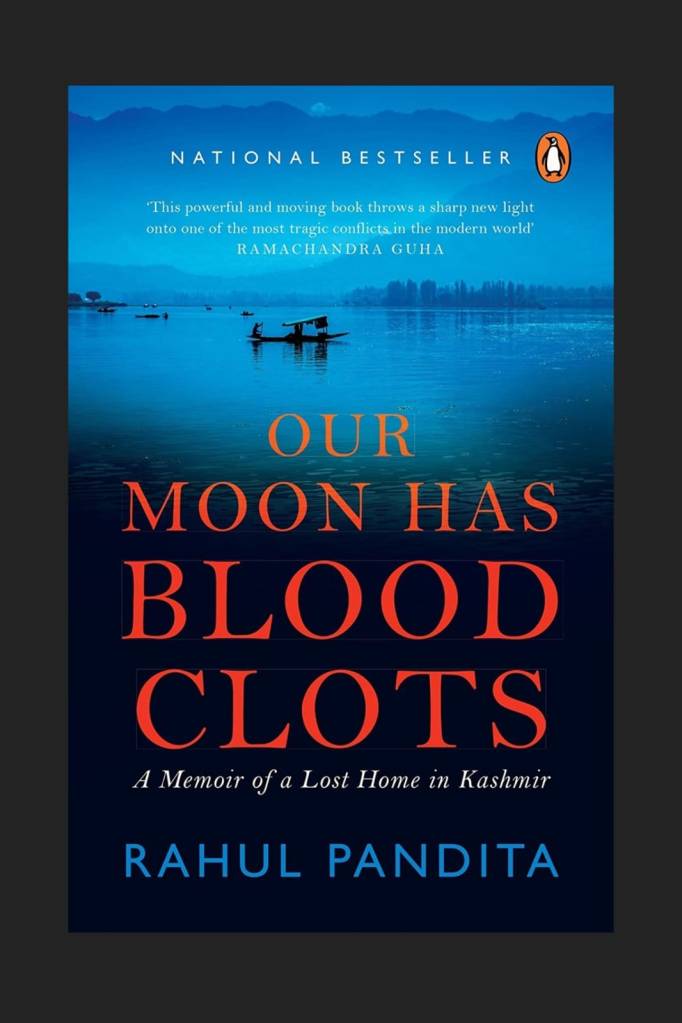
    BOOK 2: OUR MOON HAS BLOOD CLOTS

    I had waited for a long time to be able to start reading this book. It required mental preparedness before diving deep into this one, as I had decided to try to go with an open and neutral mind.

    Kashmir has always been an extremely sensitive and polarizing topic among everyone, and during the debacle around Kashmir files, I realized that my generic opinion about the state lacks substance and knowledge behind it. I had decided to go through the movie after I have read this book and a few more before I can watch it from a clearer perspective and then form an opinion on it. As I’ve just read one book, I’ll not be talking on the direction of it in general but would just like to share my experience with it.

    Usually, the books which you are engrossed in, leave you with an emptiness for a while. Mainly because you are ejected out of a universe you were so deeply engrossed in. Also true for me as I am mainly a fiction reader. But there was no way out of this experience, as I couldn’t find a way out of reality. Why I read about it so late, was the first question that it jabbed me with, followed by many more. The book was not simply about the exodus of Kashmiri Pandits, but the history of the generations finding them at the receiving end of something they never asked for, and never deserved. Their reality of having stripped of the place they called home, not only in Kashmir, but in India, leaves you with a very bitter taste. The tone that Rahul has maintained throughout the book was beautiful. He had all the reasons to be the accuser and label the accused, but he narrated it in a “what happened and the way it happened” way. It is the story of what Kashmiri Pandits went through ages, exactly that. I was nervous while reading it, but it surprised me, gutted me, and brought a tear to my eye. I am happy that I chose this book to be the first read about this topic.

    BOOK 3: TUESDAYS WITH MORRIE

    Another book I took my time with before getting into, for one it was very highly recommended by a friend, which at times messes with your expectations. And secondly, is life philosophy based, which is one broad genre I usually avoid. Even though I like the topic in general, but not in a focused way, as I like to pick my own philosophies out of random places rather than being mouth fed. Which made it even more important that I am ready for what the book has to offer while keeping my bias aside and accepting it for what it is. I went completely blind on this one, and by the end I wanted to know if Morrie was real. I was happy to find that it was a memoir, as it gives a sense of credibility to the existence of the Morrie I read about. The book goes through the topics that the current generation of any period faces, from the perspective of a wise old professor who is awaiting his curtain call, and his old student who has taken the road am earlier version of him wouldn’t have wanted him to. Morrie’s confrontation of his imminent death due to ALS, brings his student back in touch with him, and their last discussions on certain topics brings us this book. They talk about love, family, marriage, forgiveness, death, purpose of life, aging, and a few more, contemplating the questions listed by Mitch, answered by experienced Morrie. His line, “Only when you know how to die, you can learn how to live”, is a nugget I have picked that resonated with me.

    As a memoir, it was a beautiful collection of the time spent by Morrie with his estranged favorite student, along with his heartwarming final journey committed the way how he learned to believe in. I personally found the overall life hack treatment rather generic, and, on the surface, as whatever Morrie had to offer was definitely the teachings of a wise experienced man, but I couldn’t find anything uniquely new, or something that would leave you with a new perspective. Rather, I did feel that a few conversations were oversimplified, maybe if dug deeper by Mitch could have gotten more detailed, but his continuous self-guilt didn’t let them dive deeper into it.

    The relationship of Mitch and Morrie is definitely something one would wish to seek. The small nuisances of Morrie described by Mitch, from his professing days to the day he found it almost impossible to get a word out of his mouth and was bedridden, let’s you vividly see Morrie throughout his journey, which is beautiful and melancholic at the same time.
  • “कौन हो तुम” – Poem

    “कौन हो तुम” – Poem

    कौन हो तुम?
    जो बांधते हो मुझे मेरी ही पौराणिक छवि से
    और दागते हो आज ये सवाल
    कि क्या मैं मैं हूँ कि नहीं?

    कौन हो तुम?
    जो मेरे सवालों के मेरे ही जवाबों को
    अपने सवालों की कसौटी पर कसते हो
    ये कहते हुए कि तुम तो ऐसे थे नहीं?

    कौन हो तुम?
    जिसके अपने अज्ञात सत्य की तलाश
    मेरे अर्धसत्य में निहित है
    परन्तु इसका मुझे कोई ज्ञान नहीं?

    कौन हो तुम?
    जिसका अंधविश्वास कायरता की बुनियाद पर
    मेरी दिशा को दिशाहीन ठहराता है
    और मेरे विश्वास को मारी हुई मति?

    कौन हो तुम?
    जिसकी डगमगाती नींव को
    मेरे प्रश्नों से कम्पन महसूस होती है
    और मैं ज्ञात होता हूँ शत्रुरूपी?

    कौन हो तुम?
    क्यूंकि जो भी हो तुम
    मेरे दोस्त, कदापि नहीं।

  • IN SEARCH OF THE EFFORTLESS JOY WE LEFT BEHIND

    IN SEARCH OF THE EFFORTLESS JOY WE LEFT BEHIND

    My earliest memory of a family wedding is the one which took place in the winter of 2000, 26 of January. My younger Mamaji got married when I was in 3rd std. I remember the functions went on for 2-3 days with the entire house filled with family members, where everyone was providing a helping hand in everything happening around inside a house filled with festivities. Everyone was busy, everyone was enjoying, everyone was happy. That’s how I remember it. And today, I wish only if it could still feel that easy.


    We are standing 22 years after, trying to replicate the same atmosphere, with none of the same inputs present. Maybe that is the main problem behind trying to recreate nostalgia within the absolute lack of the same dynamics, circumstances, resources, time and thought process. I’ve heard this multiple times, “Marriage is the starting of a relationship not only between two individuals but two families.” and I have wondered how important does the role of the perception of the wedding plays in it.


    No, I am not questioning solely the extravagant weddings, the ones with pre-wedding photoshoots and trailers, but any preconceived notion about how a wedding is supposed to be. Some associate the inclusion of all the people who have ever sent a wedding invitation to your family, as a valid entry into the guest list. Some feel that until and unless the baraatis have coiled on the concrete road to the tune of an handkerchief imitating a magical musical instrument, also termed as “Naagin Dance” in some areas of the country, the wedding is incomplete. From compulsorily having a chaat/coffee counter, to playing the correct entry song for the bride/groom’s appearance on the stage, the wedding validation parameters feel innumerable, absence of any of which might have a detrimental impact on the participant’s experience of the same.


    On top of this, COVID 19 has opened a new door, the view of which is being equally loved and hated by wedding enthusiasts. Virtual wedding is both a boon and a curse for these wedding enthusiasts. Whereas a fraction of people are loving the minimalistic setup with the possible appearance of only near and dear ones, even virtually at times, with the overall budget dropping exponentially, another segment has put a pause on their wedding plans until lockdown opens, otherwise live Naagin Dance kaise dekhenge?


    Coming back to the dilemma, it is not easy liking the idea of a wedding that needs to take place in a banquet hall when your ideal wedding would either be court marriage, a plain temple wedding, or any simpler format if available (also read as virtual wedding, runaway wedding). An event where the parents do not spend a single penny, and the bride and groom have the right to choose to spend if anything at all seems fair. But these choices do not usually seem very inclusive of near and dear ones who would like to be a part of your big day. Hence, the more “balanced” way to spend one of the most important days in your life, is to make it a family event, which ideally is not that bad of an idea. Other than the fact that it is going to be a financial burden on any newly married couple, unless they end up asking their families to sponsor the wedding, or a part of it.


    A better idea, would be for the selected venue/city to be the one where either family resides so that the preparation burden and costing could be reduced substantially, only if the circumstances allowed it. Hence, in an attempt to chase something witnessed 22 years ago, amidst possible COVID wave 3, you might end up finding yourself in something that you should have been happy about, but feel more trapped in.


    It is not as if a version of it is not possible at all. A version where your near and dear ones would be able to gather along to celebrate the day with the couple and shower them with their blessings. But the way it seems to be fulfilled in the current scenario, with the situations and limitations at hand, does not fall under the general wedding perception. And saying a no to what has been taken up, comes with a cost that is equally heavy as the cost of going through.


    All that can be done now, is to watch the clock strike 22, and be a part of the race until you reach the finish line. Doesn’t matter at what number, more so if you are riding the ghodi.

  • MY RELATIONSHIP WITH CHANGE

    MY RELATIONSHIP WITH CHANGE

    Recently, my relationship with a certain word has been in a difficult position. I thought it had mended after struggling for so long over the years, but was found otherwise. The word is “change”.

    My journey to reach where I stand currently has been quite long. I started from being the boy who wanted a few constants in his life forever, and then I was the wreck, who seethed at the state of those constants after almighty time shaped them beyond familiarity then. Finally, I was able to understand that the “not so familiar” constants then, were not the only part of the equation that determine the changes. It took me quite some time to accept, that I changed too, which also changed the equation, making those constants more distorted than they were. Only then I was able to make my peace with the changing relationships with the people around me. With the fact, that how a friend for whom I switched a school once, is now a friend whose profile I find at times in my IG while scrolling. Or the girl for whom I travelled 400 km in a day once, is now someone I accidentally skipped wishing on her b’day. I am not saying that all these changes happened because of them or me. Change happens due to multiple reasons, but we are one of those reasons too. So when things start to feel not the same, the first thing that needs to be checked is us.

    Before diving more into it, I need to clarify a basic thing which many times people assume about change. Change is neither good nor bad. Change is change, like a fact. The outcomes of it are what hit people differently. And because the outcomes have their relevance aligned with the people they impact; they can be molded by those people themselves. If tomorrow rain occurs in the middle of the advent of summer, which would be a change, its outcome to someone like me who travels daily would be pleasant weather to ride my bike in, but for a farmer who was waiting to harvest his/her crop over somewhere else, would possibly cry tears of blood. So the question that asks to be answered here is, how blaming the change can be the solution to the problem if the outcome depends on who took the impact? You cannot control the change. What you can control is always the outcome.

    Coming back to my difficult relationship with change, it has been in this state due to the perceived meaning and notion around it. My life currently has a lot of factors that have contributed to the changes occurring in it. These changes are as varied as an increase in my curiosity about the social scenarios around me, to being in a relationship with an amazing person, to changes at work, and many more. These changes are connected through many different threads with different outcomes for me and people affected by me. As the outcomes differ for everyone, the impact they have on everyone is different too. But the difference between outcomes and changes are not very clear in the eyes of people, which has put all the burden the outcomes were supposed to carry, on the changes themselves.

    Tell me honestly, if you never have been a part of a similar conversation, when a person in your group has recently started seeing someone, as a result of which they spend less time with you, and the talk that happens in the group is, “Since they have been in the relationship, he/she is changed. He/she doesn’t even hang around much.” The simple outcome, which was the lack of availability of the person, which due to any reason was an issue, is directed instead to the change. Even I have been a part of such conversations. Change is crucial to be understood to deal with the outcome, but that’s where the role of the change ends. It’s the outcome that needs to be addressed. At times there are some outcomes that can only be modified if the change itself is modified, or is changed itself, even then, the process has to be the same.

    My relationship with the word started straining when the people around me, especially the ones closest to me, started negating the fact that the outcomes that they are being affected by, are not due to the changes, or me, but them. This stressed relationship between them and the outcomes is being transferred to my relationship with the changes, knowingly or unknowingly. It is also having different kinds of impact on me, both short term and long term, making me question if what I am doing is enough, where I do not even know what I am supposed to do. I find myself consistently defending the changes I am proud of, and that is not a healthy thing at all. When I start thinking about it from a third person’s perspective, it terrifies me to imagine what others would go through in the same scenario. I deem myself to be a pretty confident person, but I find myself questioning my own decisions and what other possible paths I could have taken, leading to even questioning if the changes in question are right for me in the first place. It is like carrying a burden that is not even yours, for no reason, and it is not helping anyone.

    Which brings us to another question, to what extent are you responsible for mending the relationships of the people around you with the outcomes of the changes? This question does not have a simple answer, still to put it in a statement addressing the utmost priority, I would say, to the extent beyond which it does not have any deteriorating effect on you. You can only help someone if you are in the right headspace. With that sentiment taking top priority, there is no expiry date to the duration or maximum capacity barrier to the load you can offer support to. It requires patience and self-belief to navigate through it.

    This piece was a part of therapy for my relationship with the changes in my life that I needed to put into a proper perspective, and I think it has solved its purpose. For anyone who reads it, I would like to urge you to keep asking yourself about the distinction and work towards outcomes of the changes, so that you and people around you could absorb changes, as they intend to be. After all, change is the only constant in this world.

  • “STENCH” – Poem

    “STENCH” – Poem

    Inside my closet full of apparels
    for extravagant appearances,
    flaunting one for every trait,
    from empathy to patience,
    lies an old smelly sock
    of pettiness, my favorite.

    For each attire I don,
    the distinct stink of pettiness
    lurks beneath.
    A tussle to dazzle the eyes,
    to confuse the nose
    pointing at my feet.

    Don’t get me wrong.
    I am not ashamed of the sock,
    I secretly own it.
    This façade is a constant reminder,
    to separate the stink
    from the stale stench
    of my naked being upon it.