
The theme for this year has been new beginnings. Whether it is with someone new, or with the ones known since eternity. Eagerly awaiting at the starting line or simply gazing at a new inning. Starting a new chapter, or rediscovering old ones. Either way, this year has given a lot to think about and on top of it, to start about.
So, adding a few things to the existing list, I decided to slowly rediscover a few long-lost interests, which have been kept alive in different ways, but not how they used to be.
Starting with my reading habit. I was lucky to get hold of a few books to kick-start it in the month of November. These are in no way recommendations, but an attempt to catalogue and continue the reading henceforth. I will be sharing in brief, what the books left me with, but these are my personal opinions, and should not be instrumental in deciding your opinion of the book, unless you share my taste or viewpoint.

BOOK 1: WAR OF LANKA
Fourth installation of the second series by Amish. I was intrigued by the universe created by the amalgamation of Lores, myths, mythology and logic created in the Meluha series. Even as a work of fiction, it appealed to me as a sounder and more believable version of the stories I have read all my childhood of God and Godhood. The beautiful geographical expanse underlying as one of the key binders of the fiction with the hints of reality made it exciting. This book was the meeting point of the previous three books of the series, from where the story collectively moves forward. With all the good things intact from what you expect from an Amish’s book, I was minutely underwhelmed by two aspects of it.
The Battle of Lanka is a story very well known, and the cultural significance and grandiose of the event maybe caused the slight unsynchronized expectation and the practical treatment of the battle. Due to it, I found myself many times eagerly waiting to see how a few crucial events of the battle unfurl, only to find them explained or covered in a brief but pragmatic way. It took me a few pages later to realize that the event has passed, and we have moved forward with the story. The battle of Lanka lasted for 3 days, and they actually passed by quite quickly. The second aspect of it was the assumption that it would be the conclusion of the series, which you realize around halfway, might not be the case. The final arc is going to be around the conflicting philosophies, which was established from the first book, but its climax would be post the battle of Lanka, was something I didn’t expect, but made complete sense.
The book didn’t hold a lot many twists but went towards a comparatively predictable path, however, as this series is the prelude to the Meluha series, the awareness of the impacts that the current situations and ideologies would bring in the times to come, what it intended and where it finally found itself, is beautiful, and compels you to pick up the Meluha series again. I am looking forward to reading both the series in its chronological sequence once this series is over.
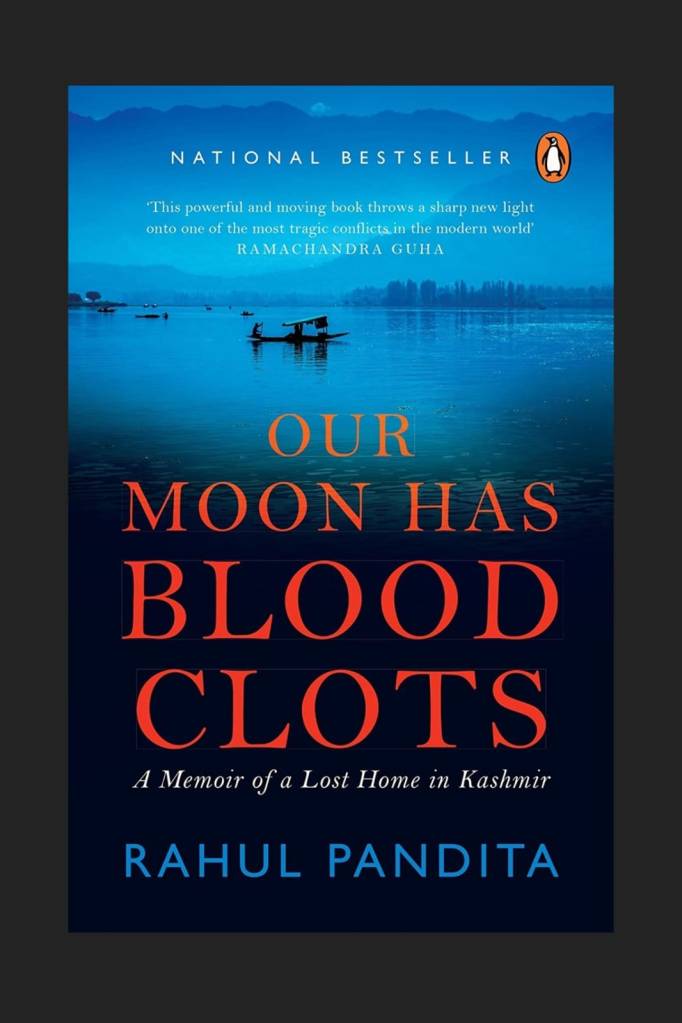
BOOK 2: OUR MOON HAS BLOOD CLOTS
I had waited for a long time to be able to start reading this book. It required mental preparedness before diving deep into this one, as I had decided to try to go with an open and neutral mind.
Kashmir has always been an extremely sensitive and polarizing topic among everyone, and during the debacle around Kashmir files, I realized that my generic opinion about the state lacks substance and knowledge behind it. I had decided to go through the movie after I have read this book and a few more before I can watch it from a clearer perspective and then form an opinion on it. As I’ve just read one book, I’ll not be talking on the direction of it in general but would just like to share my experience with it.
Usually, the books which you are engrossed in, leave you with an emptiness for a while. Mainly because you are ejected out of a universe you were so deeply engrossed in. Also true for me as I am mainly a fiction reader. But there was no way out of this experience, as I couldn’t find a way out of reality. Why I read about it so late, was the first question that it jabbed me with, followed by many more. The book was not simply about the exodus of Kashmiri Pandits, but the history of the generations finding them at the receiving end of something they never asked for, and never deserved. Their reality of having stripped of the place they called home, not only in Kashmir, but in India, leaves you with a very bitter taste. The tone that Rahul has maintained throughout the book was beautiful. He had all the reasons to be the accuser and label the accused, but he narrated it in a “what happened and the way it happened” way. It is the story of what Kashmiri Pandits went through ages, exactly that. I was nervous while reading it, but it surprised me, gutted me, and brought a tear to my eye. I am happy that I chose this book to be the first read about this topic.

BOOK 3: TUESDAYS WITH MORRIE
Another book I took my time with before getting into, for one it was very highly recommended by a friend, which at times messes with your expectations. And secondly, is life philosophy based, which is one broad genre I usually avoid. Even though I like the topic in general, but not in a focused way, as I like to pick my own philosophies out of random places rather than being mouth fed. Which made it even more important that I am ready for what the book has to offer while keeping my bias aside and accepting it for what it is. I went completely blind on this one, and by the end I wanted to know if Morrie was real. I was happy to find that it was a memoir, as it gives a sense of credibility to the existence of the Morrie I read about. The book goes through the topics that the current generation of any period faces, from the perspective of a wise old professor who is awaiting his curtain call, and his old student who has taken the road am earlier version of him wouldn’t have wanted him to. Morrie’s confrontation of his imminent death due to ALS, brings his student back in touch with him, and their last discussions on certain topics brings us this book. They talk about love, family, marriage, forgiveness, death, purpose of life, aging, and a few more, contemplating the questions listed by Mitch, answered by experienced Morrie. His line, “Only when you know how to die, you can learn how to live”, is a nugget I have picked that resonated with me.
As a memoir, it was a beautiful collection of the time spent by Morrie with his estranged favorite student, along with his heartwarming final journey committed the way how he learned to believe in. I personally found the overall life hack treatment rather generic, and, on the surface, as whatever Morrie had to offer was definitely the teachings of a wise experienced man, but I couldn’t find anything uniquely new, or something that would leave you with a new perspective. Rather, I did feel that a few conversations were oversimplified, maybe if dug deeper by Mitch could have gotten more detailed, but his continuous self-guilt didn’t let them dive deeper into it.
The relationship of Mitch and Morrie is definitely something one would wish to seek. The small nuisances of Morrie described by Mitch, from his professing days to the day he found it almost impossible to get a word out of his mouth and was bedridden, let’s you vividly see Morrie throughout his journey, which is beautiful and melancholic at the same time.
 ABSINRAW
Leave a comment